Fractional Chief AI Officer
A fractional Chief AI Officer for growing businesses
A fractional Chief AI Officer, or fractional CAIO, is a senior AI leader who works for your company part time. They own the AI strategy, decide what to do first and roll it out on purpose. Drag6 offers this to companies with 10 to 250 people.
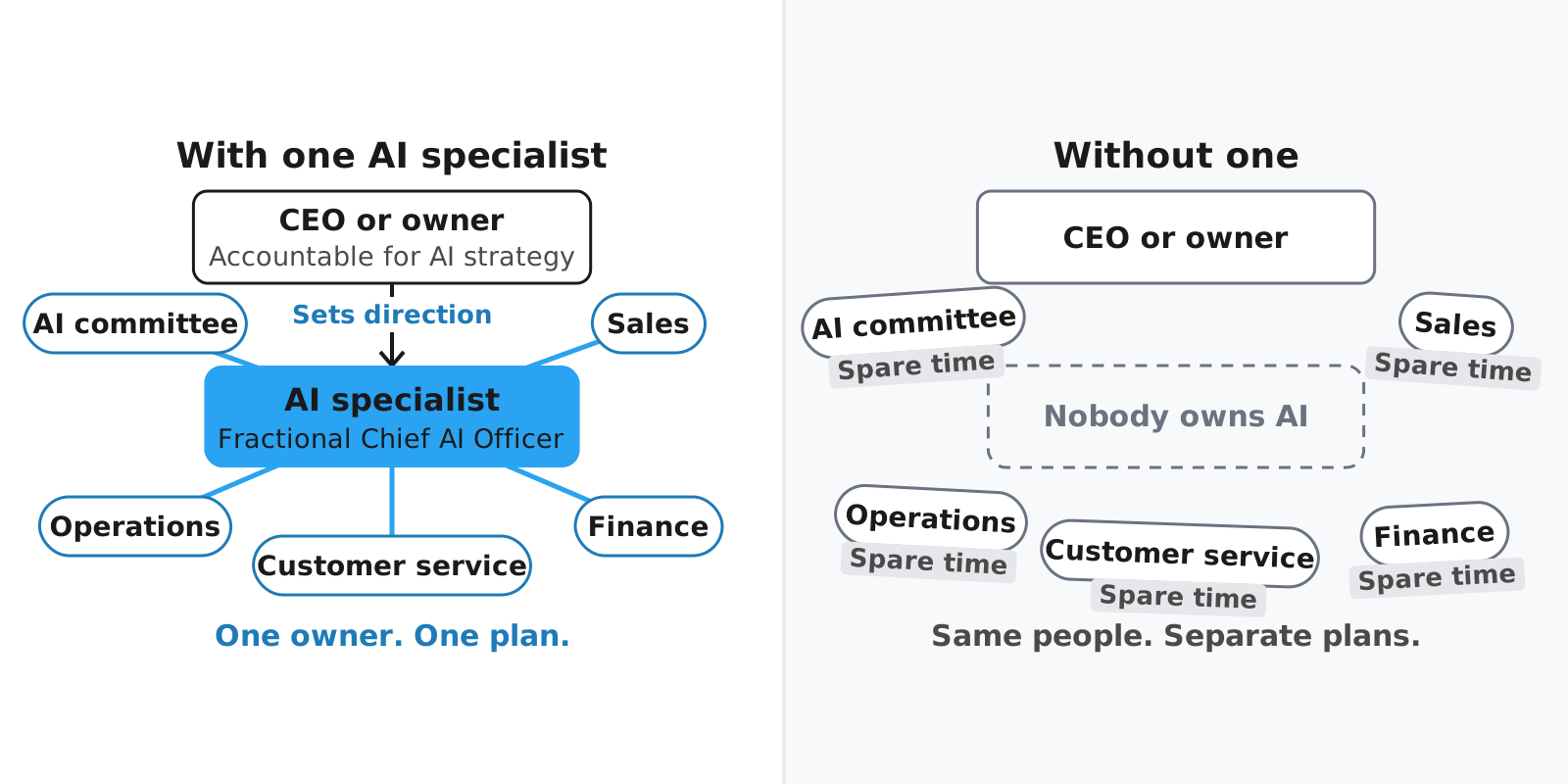
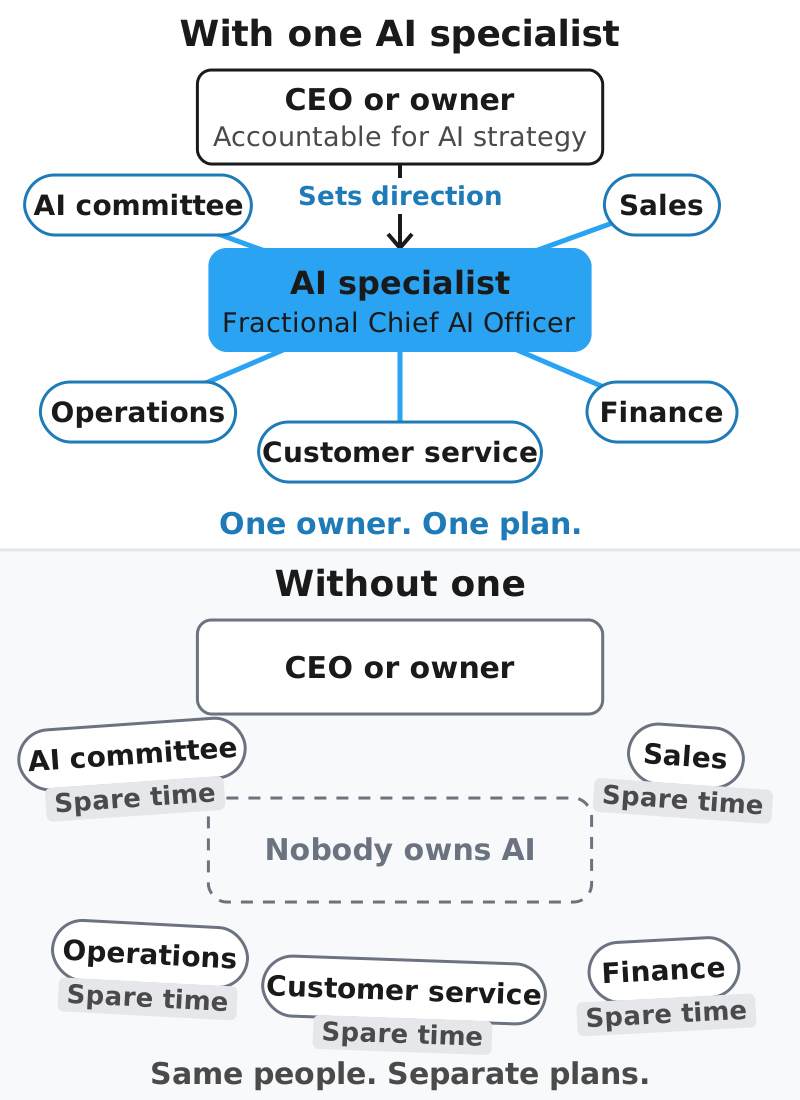
Three ways companies run AI without an owner
Most companies don't have anyone whose job is AI, so they cover it in spare time. We see three setups again and again. Good people build each one, and each one breaks in its own way.
The committee, in spare time
Committees are good at making decisions. The trouble starts when a committee is asked to run AI in its spare time. Say six people meet for two hours. That's 12 hours of company time, or a day and a half of work, in one meeting. Then everyone goes back to their day job with a list of to-dos and chips away at it between other work. If the next meeting is weeks away, the list waits until the last few days. AI gets whatever time is left over.
The department heads
Each department head owns AI for their own area. They hold meetings, send surveys and compare tools, and each team builds its own habits. But department heads are busy, so the plan follows whatever they tried last or heard about on the drive in. Nothing ties the teams together, and unless one of them loves this stuff, the work fades when things get busy.
The interested volunteer
Someone who's excited about AI offers to lead it. They're often the best person you have for it. But they still have a day job, and there aren't enough hours for both. The AI work stalls, takes much longer than it should and loses its focus.
What they have in common
In all three, AI is a side job. Each time someone puts the day job down to pick AI up, they have to get back up to speed, and when they put it down again, some of it gets lost. In one study, interrupted work took about 25 minutes to get back to, and almost a quarter of it wasn't picked back up that day.
Short on time, people rush the plan and rush the work. And when nobody in the room knows AI well, the same costly mistakes show up again and again. Nobody knows how AI affects your business, where it fits best or the steps that lead to real value.
Good people are doing their best inside a setup that works against them. AI will touch every part of your business, so it can't run on spare time. It needs one owner and one plan the whole company works from.
How a fractional Chief AI Officer works with your team
We work with your committee and your department heads, and we don't replace them. Together we build the strategy and pull everyone's AI work, including what's already underway, into one picture. Then we get into the details of your business, side by side with your teams. We look at how the work gets done today, which tools fit which departments and where things can run more smoothly. We also bring new ways to think about your business. Your committee and departments still do the work, and now it adds up to one plan.
The buck stops with the owner
In a smaller company, the buck stops with the CEO, owner or founder. You can hand off the work, but the AI strategy is yours. We help you find it and put it into words, so your team can roll it out and get it done.
Is AI a side job at your company? Book 30 minutes.Footnote: Six people for two hours is an example, not a study figure. The 25 minutes and "almost a quarter" come from a UC Irvine study of 24 information workers (Mark, Gonzalez and Harris, CHI 2005): 25 minutes 26 seconds on average to resume interrupted work, and 22.8% not resumed the same day.
Why a second job doesn't work
In a national survey of small business workers, 41% said "it is unclear how AI applies to their specific business" (U.S. Chamber of Commerce Foundation and Ipsos, June 2026, 1,070 workers). In SAS and IDC's survey of 1,600 small and mid-sized companies, 45.6% said they have "no dedicated internal or external experts for AI," and 44.8% had "no structured view of their AI use cases." That survey was paid for by SAS and its US firms are larger than most of ours, so we use it as context.
Switching
Researchers at UC Irvine followed 24 information workers. When interrupted work was picked back up, it took an average of 25 minutes 26 seconds (Mark, Gonzalez and Harris, CHI 2005). And 22.8% of interrupted work wasn't picked back up the same day.
The day job wins
In PMI's Pulse of the Profession 2018 (5,402 project professionals), 39% named "change in organization's priorities" as a primary cause of failed projects, first on the list. The day job has customers and deadlines this week. AI's costs show up later. That's our view, and the survey is the sourced number next to it.
A peer asking peers
Prosci reports that projects with extremely ineffective sponsors were only 27% likely to meet their objectives, compared with 79% with extremely effective sponsors. 79 ÷ 27 = about 2.9 times as likely. In Prosci's 2023 study (2,668 respondents), employees preferred the CEO for why the business is changing (37%) and their own supervisor for how it affects them (58%). A peer is neither of those.
How it works
Every fractional engagement starts the way any new leader's first 30, 60 and 90 days do: learn the business, its AI strengths and weaknesses and its goals, build the strategy, then run it. The strategy has three parts already on the engagement page: a survey of the team and leadership, a working session with leadership, and a strategy with a 90-day plan. After that, the work continues in 90-day cycles.
What the strategy leaves you with
- A company profile across six areas.
- An opportunity map.
- Written AI principles.
- Rules for tools and data.
- An owner and decision rights.
- A strategy and a 90-day plan.
What it costs compared with a hire
BLS has no Chief AI Officer code. The closest federal pay category for a senior AI leader is computer and information systems managers (11-3021). The US median wage is $175,140 (BLS OEWS, May 2025). Loaded with benefits at BLS ECEC's 70.0% wages share, that's $175,140 ÷ 0.700 = $250,200 a year. SHRM's 2025 average cost to hire an executive adds $35,879.
A full-time hire in that category costs about $250,000 a year with benefits, and fractional leadership costs a fraction of that.
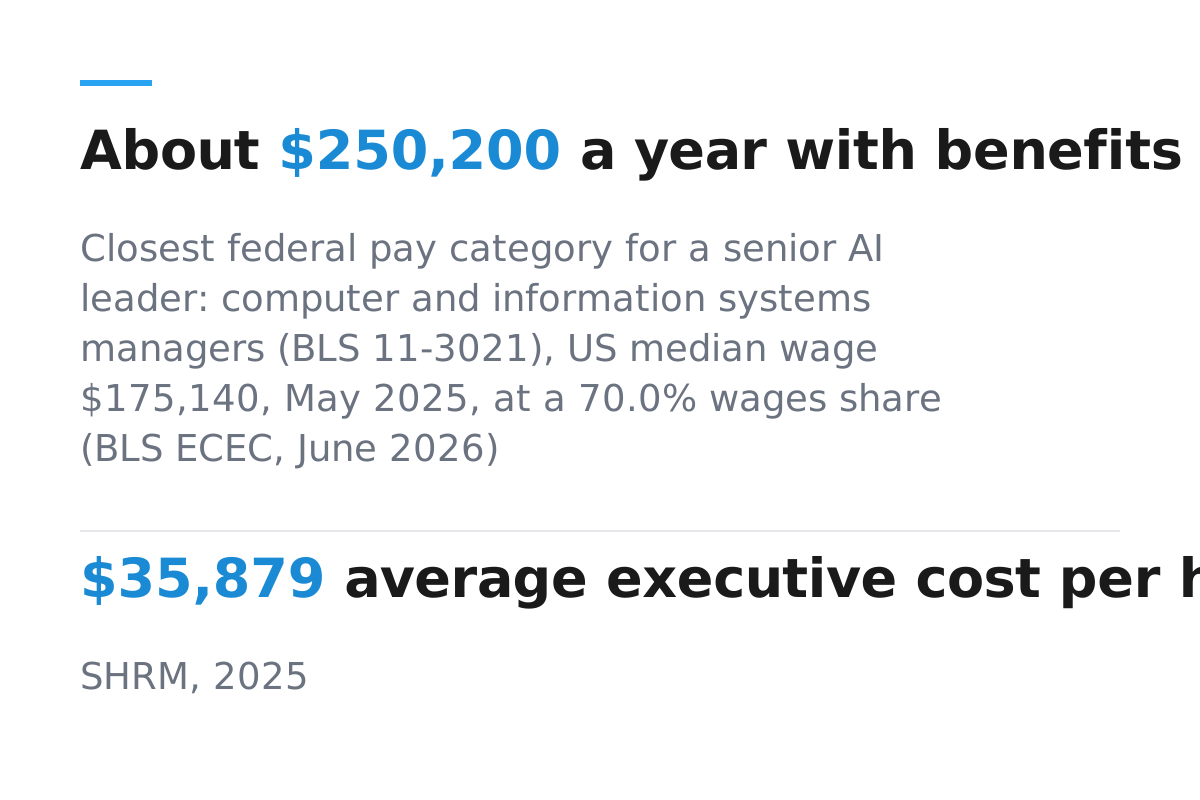
Footnote: BLS OEWS May 2025 US median wage for computer and information systems managers (11-3021), $175,140, divided by the 70.0% wages share of employer costs (BLS ECEC, June 2026). BLS has no Chief AI Officer code. SHRM 2025 average executive cost per hire, $35,879.
Keeping your data where it belongs
On the personal versions of ChatGPT and Gemini, what you type can be used to train the provider's AI models unless you turn that setting off. On Claude's personal plans, chats are used for training if you allow it in your privacy settings. The business plans and developer APIs from OpenAI, Anthropic and Google say they don't train on your data by default.
IBM's 2025 Cost of a Data Breach study found "security incidents involving shadow AI accounted for 20% of breaches," and "63% of breached organizations either don't have an AI governance policy or are still developing a policy." The sample is 600 organizations that had a breach, and IBM sells security.
Who's in the seat
We have no job to protect at your company, so we can say what's hard to say from inside.
Where are you now?
You can take the AI readiness check. Anyone can use it, no email needed. The results are a starting point, not a decision.
AI readiness checkQuestions
What's a fractional Chief AI Officer?
It's a senior AI leader who works for your company part time. They own the AI strategy, decide what to do first and keep the work moving. You get that focus without a full-time salary.
Can't we give AI to someone on our team part time?
You can, and many companies start that way. The trouble is that the person still has a day job. Every time they switch between the two, the AI work waits, and in one UC Irvine study interrupted work took about 25 minutes to pick back up. When the two jobs compete, the day job usually wins. And that person now has to ask their peers to change how they work, without the authority to make it stick. A fractional leader does only AI and comes in with your backing, so nobody on your team is put in that spot.
How does it start?
The same way any new leader starts: by learning your business, where AI can help and where it can't, and what you're trying to achieve. Our strategy work does that up front, and you get a strategy and a 90-day plan you can act on.
How does that compare with hiring?
The closest federal pay category for a senior AI leader has a US median wage of $175,140 (BLS, May 2025). With benefits that's about $250,200 a year, and SHRM's average cost to hire an executive adds $35,879. Fractional leadership costs a fraction of that.
Why not ask our own team?
You should, and we do too. Your team knows the business better than anyone, and the strategy work starts by asking them, with an anonymous survey and a working session. What an outside voice adds is room to say the hard things. When an AI option could change someone's own job, a colleague's job or how others see them, it's hard to bring up, even for great people. Research on speaking up at work finds most people have held back on something they thought was important, often to protect their working relationships. We have no job or relationship inside your company to protect, so we can put those options on the table, and your team can weigh in on them.
Doesn't our CIO or IT person already cover AI?
They might, and they're often the right partner. Most IT leaders at companies your size are already stretched keeping systems secure and running, and AI strategy asks for business decisions as much as technical ones. A fractional CAIO works alongside your IT lead, and the IT lead keeps ownership of the systems.
What happens to the tools my team has already built?
We start by finding out what's in use, including the apps and automations people built on their own. The useful ones get kept, moved to approved tools or plans where needed, and folded into the strategy. Nobody's work gets thrown out without a reason.