Buying tools isn't an AI strategy. Strategy is downstream of your business.
An AI strategy says which work AI should help with first, who owns it and what you'll leave alone for now. Tools come after those calls, not before.
Every AI tool made sense the day you bought it. Together they don't add up to a plan. In a national survey of small business workers, 41% said it's unclear how AI applies to their business.
Source: U.S. Chamber of Commerce Foundation and Ipsos, Main Street AI Monitor, June 2026 (1,070 workers at businesses with 2 to 499 employees).
- START
Your business model
Who pays you, what they pay for, and what your moat is. What AI does and doesn't do to it.
- THEN
Your philosophy
Where AI fits, where it doesn't, and how you talk about it with your customers and your team.
- THEN
Your strategy
The articulated vision. How AI serves the business, where to invest, where not to, and what the risks are.
- LAST
Tools
The specific models, platforms, and agents. Decisions that follow the strategy instead of driving it.
Start at the bottom and you get a pile of tools. Start at the top and you get a direction the tools serve.
Start this week: make the list
For every AI tool you pay for, write down four things.
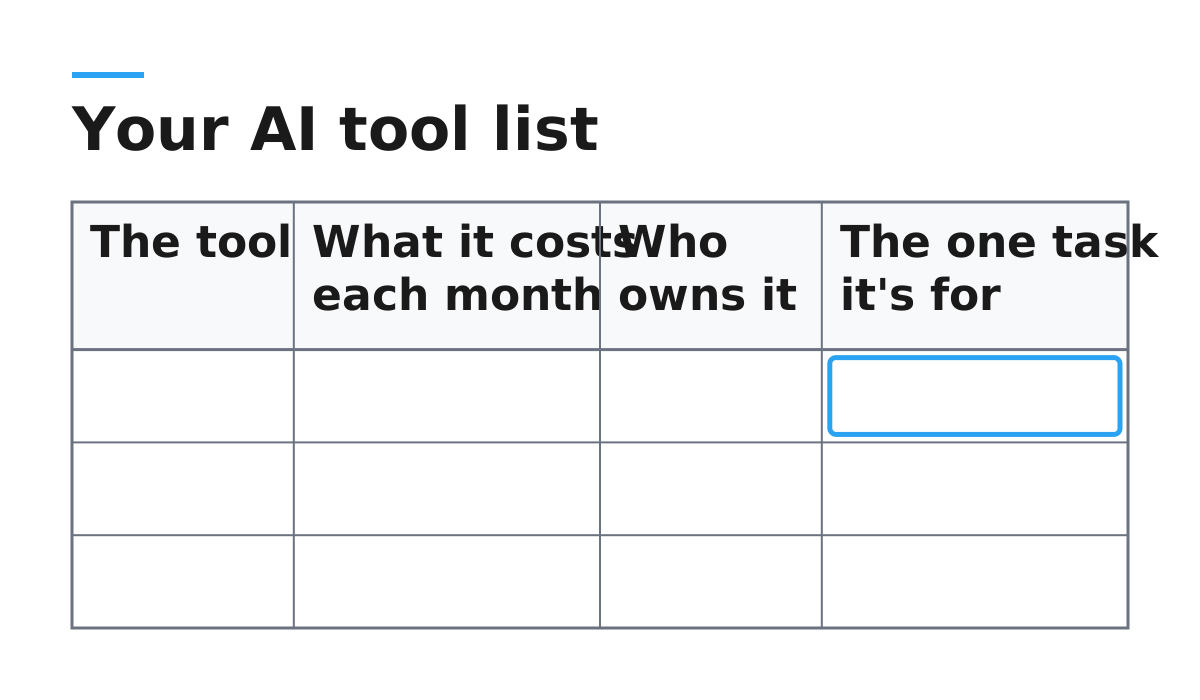
| The tool | What it costs each month | Who owns it | The one task it's for |
|---|---|---|---|
A tool with no task is your first strategy conversation.
The worksheet for that list is Sort your AI tools. Find your first AI job.. Anyone can use it, no email needed.
What the strategy leaves you with
Without a plan, AI grows on its own. Each department picks its own tools, the money goes to the loudest pitch, and nobody can say what changed. The strategy decides those things on purpose. It leaves you with six pieces, and every 90-day cycle after it builds on them.
- A company profile across six areas. Where you're strong with AI and where you're exposed, with your leaders' view next to your staff's.
- An opportunity map. The main work in your people's week, rated for time, value and energy, with the first candidates for AI marked.
- Written AI principles. What AI protects, what's off-limits and where a person always reviews AI's work.
- Rules for tools and data. Which tools are approved, which plans you pay for and what data stays out.
- An owner and decision rights. Who decides what about AI, written down.
- A strategy and a 90-day plan. What changes first and what waits, with one early win and a readout before it's final.

The AI Strategy engagement starts at $5,000. It ends with a strategy and a 90-day plan your team owns. Each cycle after that is its own decision, with no open-ended retainer.
Book a 30-minute callShould you spend $5,000 on an AI strategy? Do the math first.
One hour a week, given back to one person, is worth about $1,807 a year at a company with fewer than 50 workers. That's 1 hour × 48 weeks × $37.64, what pay and benefits cost per hour at private companies with 1 to 49 workers. Divide $5,000 by $1,807 and you get about 2.8. So the strategy pays for itself when your whole team, combined, gets back about 2.8 hours a week for a year.
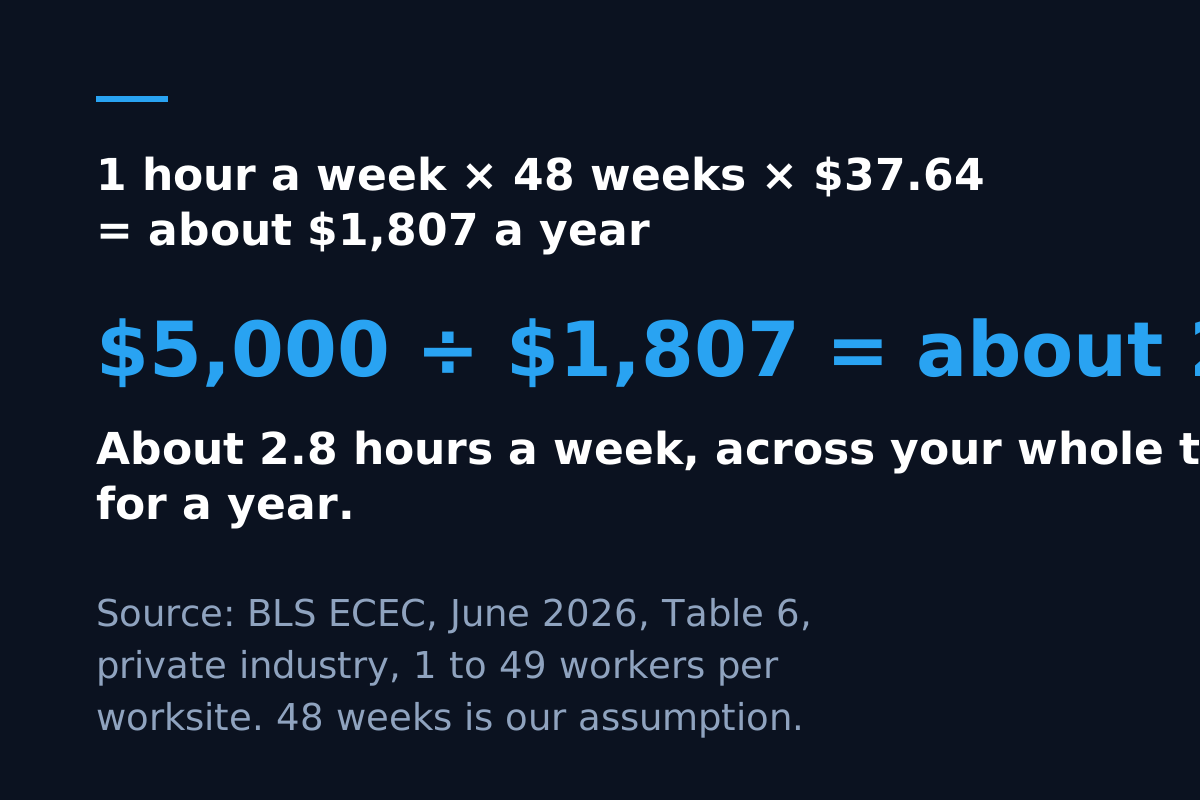
A bigger worksite costs more per hour, so the strategy pays for itself sooner. At 50 to 99 workers, one hour a week is 1 × 48 × $41.03 = $1,969 a year, and $5,000 ÷ $1,969 is about 2.5 hours a week. At 100 to 499 workers, it's 1 × 48 × $47.96 = $2,302 a year, and $5,000 ÷ $2,302 is about 2.2 hours a week.
For a bigger picture, take a 25-person company where each person gets 4 hours a week back. That's 25 × 4 × 48 = 4,800 hours a year. At $37.64 an hour, that's about $180,672 of staff time. The strategy is about 2.8% of one year of it.
Three things to keep in mind
- That's staff time valued at what you pay for it, so it isn't money saved until the time goes somewhere better.
- The work you build on the strategy costs extra.
- Nobody can promise you the hours, including us. Test the 4 hours against your own week.
Source: U.S. Bureau of Labor Statistics, Employer Costs for Employee Compensation, June 2026, Table 6: private industry, total compensation (pay plus benefits) per hour worked, by establishment size. 1 to 49 workers, $37.64. 50 to 99, $41.03. 100 to 499, $47.96. BLS counts workers per worksite, not per company. Each yearly figure is the hourly cost × 48, rounded to the nearest dollar. 48 working weeks is our assumption: 52 weeks minus about 4 for holidays and time off. These are estimates of staff time at labor cost, not a forecast, a client result or a promise of financial return.
Book a 30-minute callFour phases. Strategy is drafted, tested, refined, and handed back as yours.
A strategy is not built in a single meeting. It’s drafted from what we learn, pressure-tested with your team, refined until you recognize your own business in it, then handed back. Open any phase to see how it actually works.
The biggest risk to an AI move usually isn’t the technology.
Just like we hunt for organizational anti-patterns in our transformation work, we look for the AI-specific ones here. The most common, and the most expensive, is misreading how your own people feel about AI.
We go deep enough to give you something no tool vendor can.
At the strategy stage we are not making decisions or picking tools. We are building a clear, holistic, AI-lens picture of your business: your model, your competition, your moats and your openings, how your people actually think about AI, and where the real opportunities and risks sit. That picture is the thing you can’t get from a tool demo or an off-the-shelf framework, and it’s what every good decision afterward depends on.
Business acumen
We start with your model and your economics, so the strategy serves the business, not the technology.
Organizational understanding
We see where work and trust actually break down, including how your people really feel about AI.
Technology depth
25+ years leading real engineering organizations through real change.
Current AI expertise
Deep, current fluency in what AI can and can't do for a business like yours, right now.
You can find the recipe in a lot of places now. Cooking the meal, for your business, is a different thing.
Once the strategy is set, we help you act on it.
The approach is how we get you clear. From there, how hands-on we get depends on what you need and the capability you already have, from leadership in the seat to building the AI resources the strategy calls for.